
What Enterprises Must Get Right: Insights from Tsvetan Alexiev, CEO of Sirma Group
As enterprises set priorities for the year ahead, a clear shift in how artificial intelligence is approached is underway. AI is no longer treated as a collection of tools or isolated experiments - it is increasingly becoming infrastructure.
This transition fundamentally changes the challenge ahead. The question is no longer which model performs best in isolation, but how AI can be governed, integrated, and scaled across systems, borders, and regulatory environments. What some regions are experiencing first is quickly becoming a global pattern and the decisions enterprises make now will shape their ability to compete in the years ahead.
“AI sovereignty is no longer a theoretical discussion. It is determined by how deeply and how responsibly AI is embedded into real business processes.” Tsvetan Alexiev, CEO, Sirma Group
From Аmbition To Embedded Capability
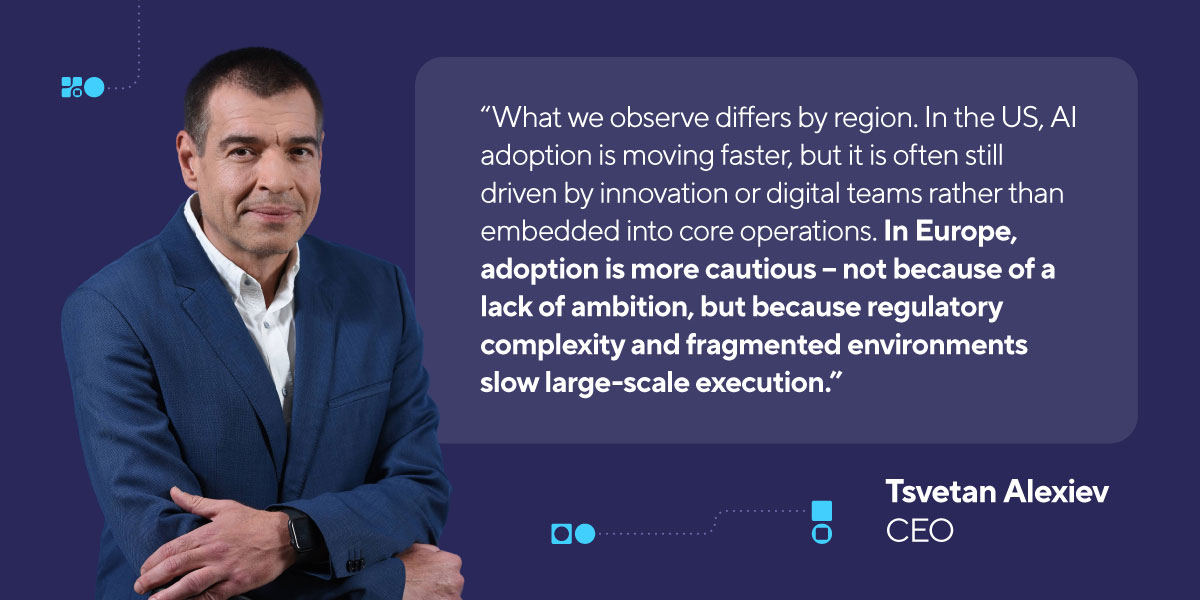
Across industries, we see strong ambition around AI and a growing understanding of its strategic importance. Yet many organizations remain in an intermediate phase, where experimentation is active but large-scale adoption is cautious.
This is not a sign of hesitation or lack of capability. It reflects the reality of operating in complex environments with legacy systems, fragmented data, regulatory obligations, and high expectations around reliability and accountability. Moving AI from isolated use cases into core business processes requires more than technology; it requires structural readiness.
This is where the distinction between AI as a tool and AI as infrastructure begins to matter.
Sovereignty Emerges Through Architecture
AI sovereignty is often discussed at the level of national policy or model ownership. In practice, however, sovereignty takes shape through architecture.
It is influenced by where data is processed, how models are orchestrated, how governance is enforced, and how dependencies accumulate over time. These choices are rarely framed as geopolitical decisions – yet collectively, they determine long-term control, resilience, and freedom of action.
For enterprises, the question becomes increasingly pragmatic: Can AI be scaled across borders, systems, and use cases while retaining ownership, compliance, and accountability? Where the answer is yes, adoption accelerates. Where it remains unclear, progress tends to slow.

Regulation Sets the Frame, Architecture Enables Movement
Regulation plays an essential role in building trust and accountability. At the same time, regulatory interpretation and pace often vary across regions and industries, creating uncertainty for organizations looking to scale.
What we consistently observe is that clarity at the architectural level often matters more than clarity at the policy level. When governance, auditability, explainability, and data control are embedded by design, organizations are better positioned to move forward, even as regulation continues to evolve.
Once AI becomes infrastructure, questions of governance, control, and interoperability are no longer optional. They become design requirements.
This is why platforms that are model-agnostic, sovereignty-aware, and enterprise-grade by default are increasingly central to long-term AI strategies.
How This Shapes Our Own Approach
These patterns directly inform how we built our Sirma.AI Enterprise platform.
Our focus is not on optimizing for a single model, ecosystem, or deployment pattern, but on enabling enterprises to treat AI as governed infrastructure – something that can operate reliably across systems, borders, and regulatory contexts without sacrificing control.
By prioritizing customer-controlled deployments, flexible model orchestration, and governance embedded at the core, we aim to support organizations as they move from experimentation toward durable, production-ready AI.
The Next Phase of Disruption
Looking ahead, the most significant shift is unlikely to come from a single technological breakthrough. Instead, it will emerge from the gradual but widespread integration of autonomous AI agents into everyday business operations.
These systems will augment human decision-making, coordinate processes across functions, and reduce friction in complex organizations. Their impact will be cumulative rather than sudden – rewarding those who have built strong foundations early.
At the same time, global AI development is becoming more regionally shaped. Interoperability will remain important, but sovereignty, compliance, and trust will increasingly influence how AI is deployed in practice.
“AI geopolitics will not be shaped only by who builds the most advanced models, but by who embeds AI fastest and most effectively into the real economy.” Tsvetan Alexiev, CEO, Sirma Group
Why the Shift to AI Infrastructure Matters
At the start of the year, many enterprises are moving from AI experimentation toward longer-term platforms and operating models; often without fully realizing how permanent these architectural choices may become.
The architectural decisions being made now, around platforms, data flows, governance, and integration, will shape what is possible later. Once AI becomes embedded into operating models, change becomes harder and more expensive.
For organizations that succeed in operationalizing AI under complex conditions, this creates a lasting advantage. They will build systems that are not only compliant, but resilient and globally competitive.