Hotels already use a wide range of systems to manage guest communication, rooms, staffing and revenue. The challenge is getting information to move between them and helping teams act on it. An AI solution needs to understand the hotel’s context, connect with the systems it relies on and operate within the hotel’s rules.
That challenge is reflected in h2c’s Global Study 2026. Among hotel chains already using or planning to use AI agents, 70% said they apply or plan to apply them in staff-facing areas. Yet only 28% report having a company-wide AI strategy led by senior leadership. Many are experimenting with AI or running pilots, while working out how to connect individual use cases across the operation. The findings point to a gap between interest in agents and the work of implementing them as part of a coordinated approach.
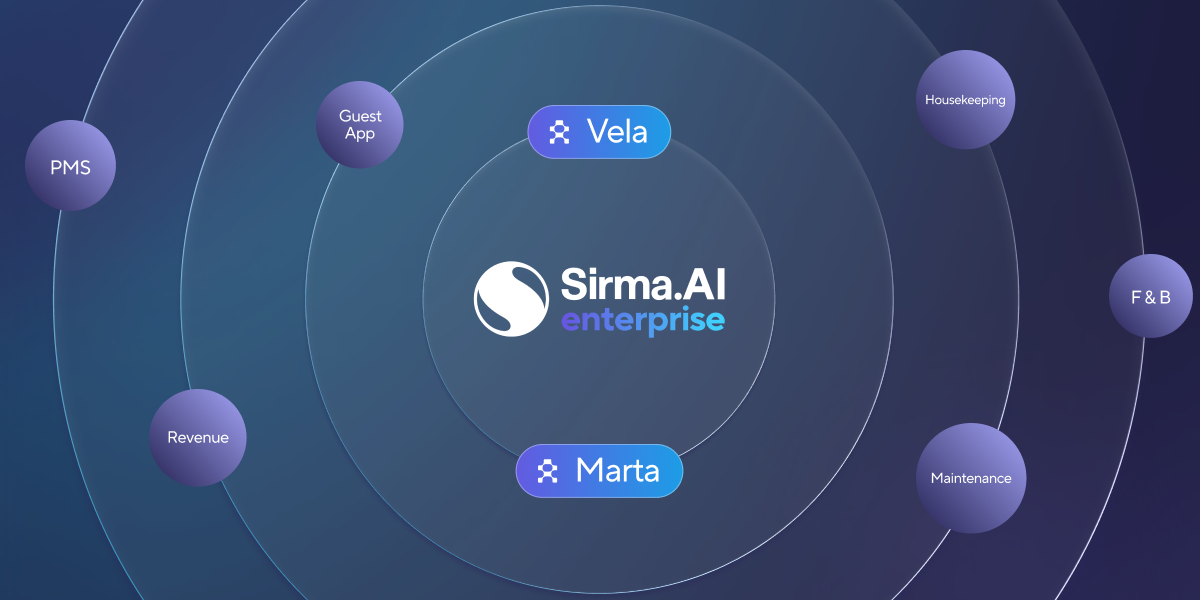
This is where Sirma.AI Enterprise comes in. It provides a platform for building, connecting and governing AI solutions in real operating environments. Vela and Marta are two examples of what Sirma has built for hospitality on that platform. They address specific needs today, and the same platform gives Sirma the foundation to develop further agents and workflows around each hotel’s priorities.
“The value of an AI agent depends on how well it fits the hotel around it: the systems it needs to work with, the workflows it supports and the rules it must follow. Our focus is on building solutions that work in the context of real hotel operations and can evolve as those needs change” said Darko Bosancic, SVP Travel & Hospitality, Sirma
A realistic hotel scenario: Gabriela’s morning
Gabriela is the general manager of a busy city hotel. At 7:45, guest messages are waiting, she has a revenue meeting to prepare for and a new team member needs support. Then a guest reports a broken shower. It’s a familiar mix of competing demands, and a realistic example of where connected AI agents can help a hotel team coordinate what happens next.
Each issue needs attention, and the information and actions involved sit across different parts of the hotel. Gabriela’s morning shows how Vela and Marta can support the guest-facing response and the wider operational picture, while she and her team remain responsible for the operation.
Vela connects the guest request to the work
The guest reports the issue through the hotel app. Vela, Sirma’s AI agent for guest communication and hotel operations, understands the request and turns it into a structured maintenance task. The relevant team receives the details, the room status can be updated, and the guest receives confirmation that the issue is being handled.
The request is connected to the operational work that follows. Instead of relying on someone to forward a message, decide who owns it and chase an update, Vela can support that sequence within the hotel’s defined workflow. The maintenance team has a clear task; the guest is kept informed. Staff remain available for situations that need personal attention, judgment or a more complex response.
Marta brings the operational picture together
While Vela supports the guest-facing request, Marta, Sirma’s AI agent for hotel teams, helps Gabriela prepare for her revenue meeting. Marta summarizes how occupancy, ADR, pickup and RevPAR have moved, explains what has changed and points out what needs attention. She helps Gabriela interpret the information, rather than simply presenting a set of metrics.
Because both agents run on the same platform, the maintenance request Vela creates is also visible to Gabriela in Marta, alongside the day’s other operational priorities. She can see Vela’s update as part of the wider picture, connecting the guest-facing response with the work happening across the hotel. Gabriela and her team use that context to decide where to focus and what action to take.
This is just the beginning
Vela and Marta are purpose-built agents, not the limits of what Sirma.AI Enterprise can support. Each hotel has its own systems, service standards and operational priorities. One may want to start with guest communication and maintenance coordination; another may prioritize staff knowledge, housekeeping workflows, bookings, revenue insight or reporting.
The platform can be configured and extended around those needs. A hotel could add a payments agent to support payment workflows, or a guest-review agent to analyze feedback and surface recurring issues. Agents can connect with a hotel’s existing environment, including its PMS, revenue management, housekeeping and maintenance systems. Their access and actions can be defined for the workflows they support, with human handovers where required.
Built on experience
Founded in 1992, Sirma has been a pioneer in AI technologies since its inception. It brings more than 34 years of enterprise technology experience and deep travel and hospitality expertise built through more than 350 projects. That combination brings together AI, engineering and integration experience with an understanding of hotel operations and the systems hospitality businesses depend on.
Sirma.AI Enterprise supports more than 500 models and enables organizations to build and orchestrate agents and workflows in a secure, governed environment. Sirma is developing a data lake capability to help hospitality IT vendors, hotel organizations and management companies harmonize structured and unstructured data, creating a new path to unlock further potential with AI. The platform gives organizations control over data access, permissions and agent actions.
Gabriela’s morning is one scenario. Vela and Marta are two examples. Sirma.AI Enterprise gives hotels the platform and Sirma brings the experience to build what each operation needs next.