
More than 30% of B2B orders today, including deals exceeding $500,000, are placed through self-service digital interfaces, without a single conversation with a sales rep. That number is growing every quarter. For manufacturers still routing orders through phone calls, email threads, and spreadsheets, this is not a distant trend to monitor. It is a competitive gap that is already widening. The companies capturing those buyers are not necessarily larger or better resourced; they simply moved to digital commerce sooner. Those who make that move today will define market leadership tomorrow.
Research confirms the scale of the shift: more than 70% of B2B decision‑makers now prefer remote or digital interactions, and companies with advanced digital commerce capabilities are growing revenue 2–3x faster than those still relying on traditional sales channels. The performance divide between digital leaders and laggards grows with each passing quarter.
The Real Cost of Standing Still
For many B2B industrial companies, sales and procurement teams still process orders by phone, email, or even fax. While building relationships may seem time-consuming, management often questions their effectiveness. Managers must consider factors such as manual ERP data entry, pricing errors, and delays in submitting RFPs and offers.
The presales stage, where companies gather, compare, and analyze offers from suppliers or vendors to find the best combination of value and price, can be very time-consuming and labor-intensive. Therefore, there is an urgent need to tackle these challenges through automation or AI solutions that can streamline the process. Additionally, creating a database for historical data comparisons would significantly enhance the competitive procurement process. Optimizing this process will help manage limited stock visibility and develop a scalable cost-to-serve model without the need to hire more employees.
As order volumes grow, so does the operational drag. Meanwhile, competitors running modern digital storefronts are quietly capturing the buyers who value speed, accuracy, and the freedom to transact on their own terms. The question is no longer whether to digitize; it’s how fast you can do it well.
The good news is that the infrastructure to make this shift already exists. Sirma team has built a B2B commerce platform on Adobe Magento, one of the most customizable e-commerce platforms available, designed specifically for the operational realities of manufacturing: complex pricing structures, multi-entity account hierarchies, ERP dependencies, and buyers who expect the same self-service experience they get as consumers. This platform goes far beyond a digital catalogue. It is a commerce operating system that manages the workflows, approvals, and integrations that modern B2B buyers expect as standard.
Self-Service That Unlocks Your Sales Team
Buyers can explore personalized catalogs tailored to their contracts, place orders, reorder from their history, and manage multi-level approvals, all without needing assistance from sales representatives. This process doesn’t eliminate the role of your sales team; instead, it relieves them of administrative tasks related to orders, allowing them to concentrate on building relationships and closing deals that truly make a difference.
Real-Time ERP Integration, Without Data Silos
Magento integrates directly with SAP, Microsoft Dynamics, and other major ERPs, keeping inventory, pricing, invoicing, and order status synchronized in real time. The operational impact is immediate: order accuracy rates above 95% and a reduction of manual order entry by over 80% become realistic targets, not distant ambitions.
Workflows That Mirror How B2B Actually Works
From complex RFQ processes and multi-level approvals to distributor portals with tiered access control, Magento reflects the real structure of B2B buying organizations. Hierarchical company accounts, spending limits, and quote-to-order conversion workflows mean the platform handles the process overhead, so your people don’t have to.
The platform also provides AI‑powered agent orchestration for RFP and quotation management, transforming a traditionally slow and manual process into a fast, structured, and scalable workflow. By automatically ingesting RFP documents and offers, extracting key requirements, and generating high‑quality, client‑specific draft proposals, the system enables teams to prepare offers significantly faster while maintaining full consistency and compliance. AI agents coordinate the entire process - from knowledge retrieval and content generation to internal review workflows, ensuring that every proposal is accurate, on‑brand, and aligned with business objectives. This reduces proposal turnaround time by 40-70%, improves consistency and accuracy, and increases win rates by delivering faster, higher‑quality responses at scale. For sales and bid teams, this means fewer bottlenecks, faster approvals, and a higher hit rate on strategic opportunities.
What the Numbers Look Like
The combined business impact of a properly implemented Magento B2B platform is substantial and measurable from early in the deployment:
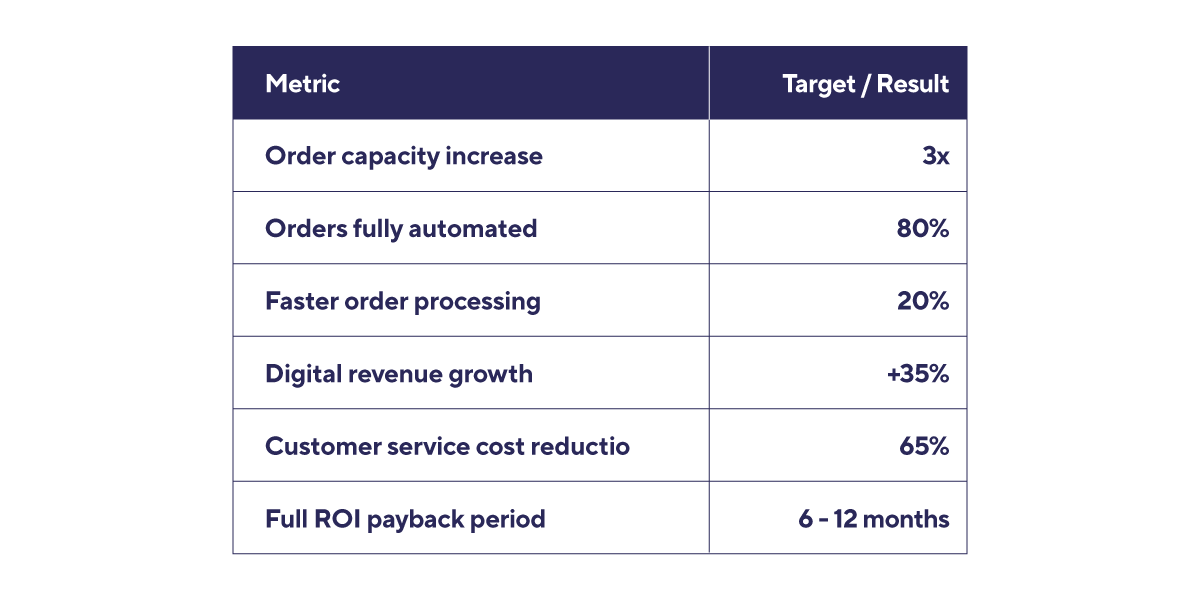 These outcomes reflect the results Sirma’s manufacturing clients achieve through structured implementation, tracked from the first month through full rollout.
Adding Intelligence: The Sirma.AI Enterprise Layer
A best-in-class Magento deployment is a strong foundation. But layering Sirma.AI Enterprise on top transforms it into an intelligent, self-optimizing revenue engine, one that learns from buyer behavior and acts on it automatically.
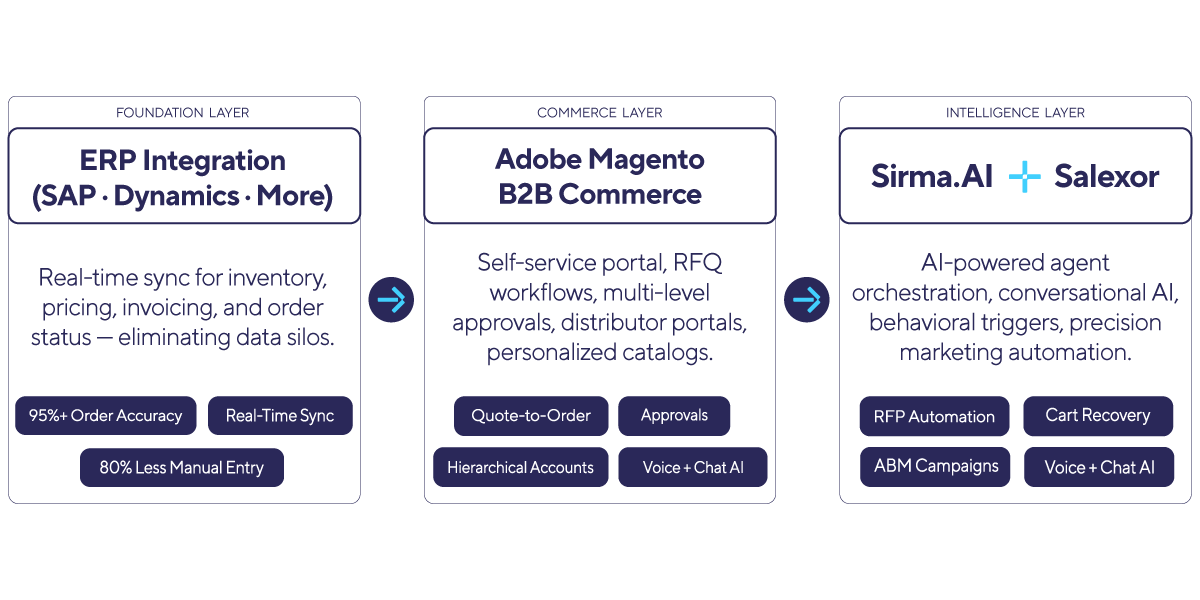
Our automated communication system, Salexor.com, integrates directly with Magento B2B as a dedicated AI layer, delivering three interconnected capabilities that operate continuously. Consider a practical example: a procurement manager at a key account browses your catalogue late in the evening, adds items to a quote, then closes the tab without submitting. By the next morning, they received a personalized message referencing those exact products, their negotiated pricing, and a reminder that a similar order last quarter qualified for volume pricing. That sequence - detection, personalization, and outreach, happens automatically, without any intervention from your team.
Always-On Conversational AI
AI text and voice agents provide 24/7 automated sales and customer support across web and mobile channels, with intelligent lead pre‑qualification, real‑time sentiment detection, and seamless handoffs to human specialists when needed. Every buyer interaction is captured, enriched with context, and followed through, regardless of time zone or business hours.
Behavioral Triggers That Convert Intent into Orders
The AI continuously monitors buyer behavior, e.g., cart abandonment, browse exits, inactivity periods, and intent score thresholds, and automatically triggers personalized recovery and re-engagement workflows. The result is a 42% improvement in cart recovery and a 28% increase in average order value (AOV). Instead of letting warm opportunities go cold, the platform acts before the moment passes.
Precision Marketing Automation at Scale
Account-based marketing (ABM) automation delivers tailored messaging per target account and decision-maker, while RFQ and quote follow-up workflows send personalized reminders and value proofs at exactly the right stage of the buying cycle. Post-purchase lifecycle automation then takes over, driving repeat orders, cross-sell opportunities, and long-term customer value without manual campaign management.
Strategic Value Beyond the Pipeline
The compounding benefits of Magento, combined with agentic AI, extend well beyond day‑to‑day order processing. Localized storefronts with region‑specific pricing, languages, and tax configurations let you enter new markets rapidly, without building separate infrastructure for each one. Rich analytics on product performance, customer segmentation, and purchasing behavior give your marketing, sales, and product teams the intelligence they need to make faster, smarter decisions. Real‑time ERP integration reduces stock‑outs and overstock carrying costs, making fulfilment both more predictable and more profitable.
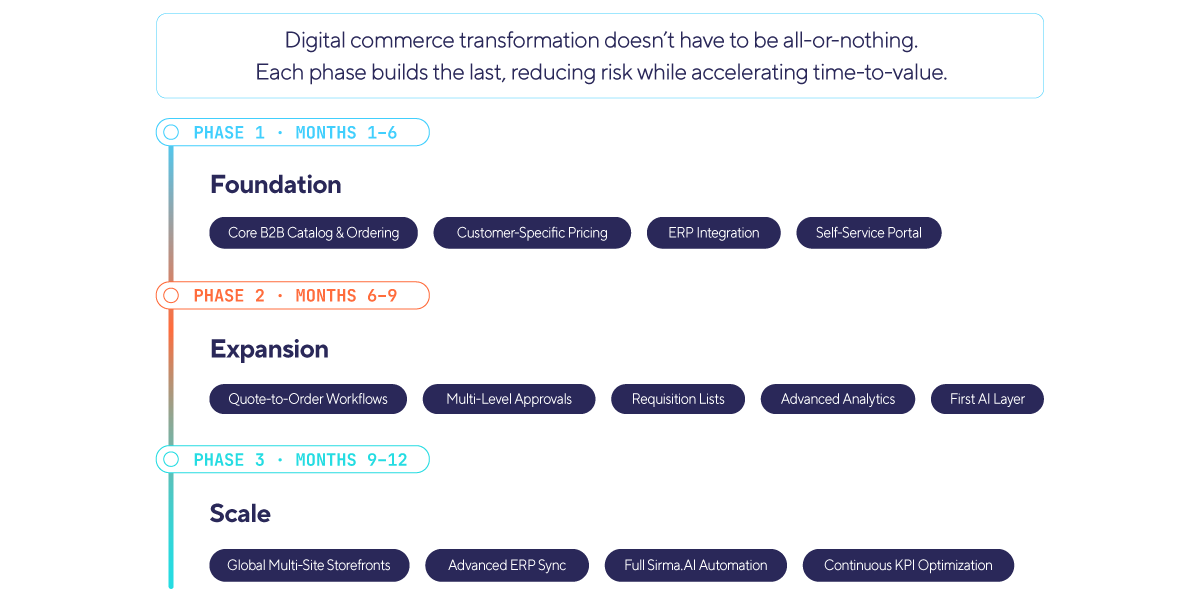
A Low-Risk Path to Transformation
The Window Is Closing: Early Movers Will Define the Market
B2B e-commerce is rapidly becoming the main revenue channel for manufacturers and their supply chain partners globally. Distributors are evolving beyond their traditional roles as intermediaries. This transformation is being driven by manufacturers and industrial companies that are establishing distributor portals with tiered access control. The emphasis is now on building and enhancing partner ecosystems that deliver greater value efficiently and at competitive prices.
As procurement teams at major enterprises increasingly adopt digital purchasing platforms, the opportunity for manufacturers to establish themselves as preferred digital suppliers is diminishing. Companies that invest now in both their platforms and AI technology will scale globally, reduce operating costs, and create buyer experiences that foster long term loyalty. Those who delay will find themselves competing solely on price through channels that their customers no longer prefer.
Sirma retail vertical specializes in advising customers on building or upgrading their e-commerce channels with tailored solutions using Magento B2B Commerce, Salexor.com and Sirma.AI Enterprise. We deliver this transformation through a structured and proven engagement model.
Are you ready to identify where manual processes cost you the most? Contact us to schedule a discovery session focused on your specific business model, order volumes, and ERP environment. You’ll leave with a clear understanding of what a phased digital commerce rollout for your organization looks like in practice.