What the Next Decade of Wealth Management Actually Requires
Wealth management has traditionally operated on a stable premise: clients accumulate assets throughout their careers, periodically consult with advisors, and pass their wealth to heirs within a limited set of jurisdictions and financial instruments. However, this premise is breaking down on multiple fronts. Assets are transferring across borders faster than regulatory frameworks can keep up with; new asset classes are attracting investment away from traditional portfolios, and the economics of advice are being transformed by artificial intelligence (AI).
According to a 2026 industry report¹ co-created by Temenos and Bain, the observed trends are not isolated occurrences but interconnected pressures that are fundamentally changing the operations of wealth management firms. The report highlights:
- Technology foundations need to modernize specifically around AI’s data requirements. Most wealth managers currently operate on legacy systems and fragmented data stores that cannot support enterprise-grade AI agents, meaning AI initiatives remain isolated pilots rather than institutional capabilities without this investment.
- AI needs to be embedded directly into advisor workflows rather than layered on top of existing processes, echoing a pattern seen elsewhere in banking where embedded AI outperforms bolted-on automation.
- Pricing communication needs to shift toward outcome-based framing, using AI-generated transparency tools to substantiate value rather than defend a percentage fee structure.
Wealth managers are now adapting to the changing identity of their clients rather than simply responding to the evolving nature of wealth itself: modern wealth is cross-border, AI-enhanced, and increasingly held in non-traditional assets, and increasingly rooted in unexpected corners of Europe.
What are the main driving forces?
There are four main factors driving this situation:
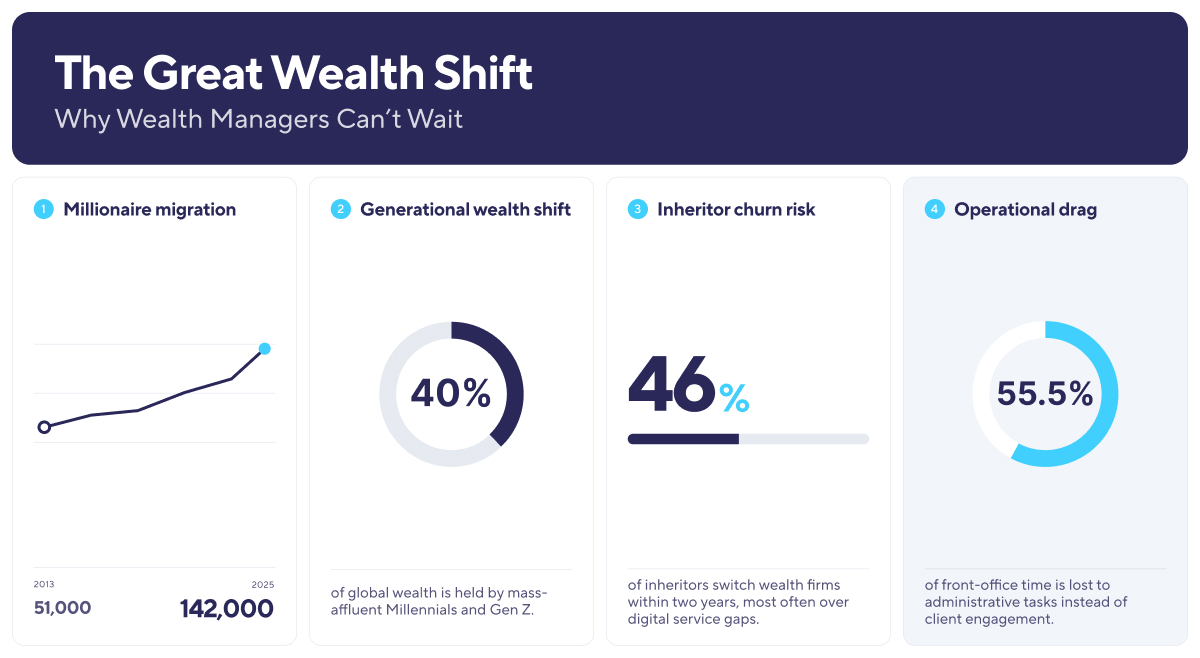
- Millionaire Migration
- Generational Wealth Shift
- Inheritor Churn Risk
- Operational Drag
Understanding this significant shift requires more than just recognizing that “younger clients want apps”; it necessitates examining how the geography, composition, and cost structure of wealth are changing simultaneously, and this is particularly evident in South-Eastern Europe (SEE).
Wealth Is Becoming Geographically Unstable
One of the clearest structural changes is the acceleration of high-net-worth migration. According to Henley & Partners’ tracking, millionaire relocation numbers rose from roughly 51,000 in 2013 to a projected 142,000 in 2025², nearly a threefold increase, driven by the adoption of remote work, shifting tax regimes, and lifestyle arbitrage; Henley & Partners now forecasts 165,000 movers in 2026 as the trend accelerates. This is not a temporary blip; movers are increasingly staying in new jurisdictions for extended periods, often exceeding six months, which triggers genuine tax residency and reporting complexity rather than superficial relocation.
This matters structurally because wealth management has traditionally been built around jurisdictional specialization, an advisor deeply versed in, say, UK trust law or US estate tax. Cross-border migration at this scale means firms can no longer treat jurisdictional expertise as a niche specialty; it becomes a default operating requirement.
Compliance functions such as KYC (know-your-customer identity checks), data residency, and securities handling are increasingly approached “through a cross-border lens by default” rather than as exceptions. Notably, this has produced a seemingly contradictory response: even as firms invest in remote and digital advisory infrastructure, many are simultaneously opening physical branches in hubs like Singapore, Dubai, and the Caribbean. In established safe-haven markets such as Switzerland, Singapore, and the UAE, foreign-born residents now make up more than half of the centi-millionaire population (those worth $100 million or more)³, underscoring why local regulatory expertise still matters even as digital delivery expands.
Fastest-growing wealth markets, 2014–2024 (millionaire population growth)
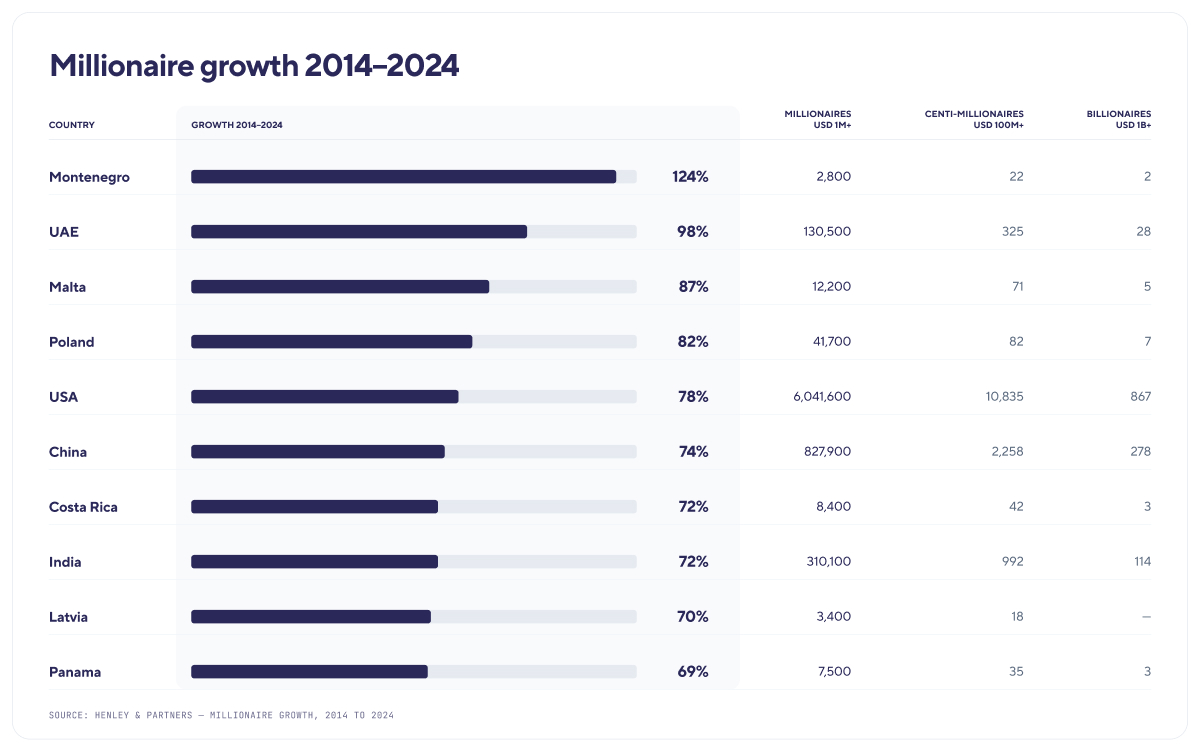
Surprisingly, some underestimated regions are striving to establish themselves as emerging hubs, and the Balkans offer the clearest proof point. According to Henley & Partners⁴, which reviewed the world’s top 10 fastest-growing wealth markets over the past decade, Montenegro tops the global list outright, with its resident millionaire population up 124% between 2014 and 2024, outpacing the UAE (98%), Malta (87%), and Poland (82%). That growth pushed Montenegro’s millionaire count to roughly 2,800 (alongside 22 centi-millionaires and two billionaires) in a country of just 630,000 people, driven by a flat 9-15% income tax, no inheritance or gift tax, its now-discontinued citizenship-by-investment scheme, and imminent EU accession prospects⁵. Poland and Latvia round out the underestimated cohort named in the same report, but Montenegro’s trajectory has become the sharpest illustration that “emerging” wealth hubs are no longer confined to the Gulf or the Caribbean.
The Composition of Wealth Itself Is Diversifying
A second structural shift concerns what wealth is actually made of. Historically, diversification meant spreading capital across public equities, bonds, and real estate. Today, investor’s appetite for private markets is expanding, particularly in fast-growing sectors like AI, but access remains largely restricted to those who meet accredited investor criteria. Tokenized assets and stablecoin-related instruments are emerging as legitimate tools for diversification rather than just speculative curiosities, with DeFi (decentralized finance platforms that let people lend, borrow, and trade without a bank as intermediary) currently estimated at about €78 billion, or roughly 4% of total crypto market capitalization¹.
This creates a genuine infrastructure problem, not just a product problem. Most wealth platforms were architected for custody and reporting on conventional securities, and supporting private-market allocations and tokenized assets requires new custody arrangements, identity verification frameworks, and transaction monitoring spanning both traditional and decentralized rails.
SEE illustrates this diversification pressure from a different angle: its wealth is overwhelmingly first-generation and highly liquid, generated by two distinct cohorts rather than inherited across generations, a tech-exporter class of founders and engineers from Romania, Bulgaria, Serbia, and Croatia’s outsourcing-turned-product hubs, and a “Mittelstand” of mid-sized family businesses in logistics, agribusiness, and renewable energy now facing their first succession transition. Bulgaria exemplifies the pace of this compounding: real per capita financial assets there have grown eightfold in recent years, among the fastest rates tracked globally alongside Romania and India. Organizations that treat diversification purely as a client-demand issue will underestimate both the operational lift required in mature markets and the succession-planning demand quietly building in the Balkans.
The Rise of the Region’s Mass Affluent
A related but distinct force is the democratization of investable wealth beneath the millionaire tier. Across SEE, an expanding middle and upper-middle class holding $50,000 to $500,000 in investable assets is growing faster than local banking infrastructure can manually service, a dynamic that echoes the mass-affluent pressures reshaping wealth management globally. Capital that once sat idle in low-yield local-currency savings or was funneled entirely into residential real estate is now being redirected toward diversified portfolios, international equities, and mutual funds as financial literacy and digital access rise. This creates a genuinely wide-open market for regional banks and fintechs able to deploy scalable robo-advisory (automated, algorithm-driven investment platforms) and hybrid models, rather than a niche opportunity confined to private banking desks.
The Economics of Advice Are Being Rewritten by AI
Perhaps the most consequential shift is happening inside the advisory relationship itself. Bain’s analysis suggests AI has the potential to roughly double relationship-manager unit economics (the revenue a firm earns per client relationship relative to its cost), with 25–30% of that improvement coming specifically from automating non-client-facing tasks such as meeting preparation and documentation¹. This is a meaningful distinction worth sitting with: the gain isn’t primarily from AI replacing advisory judgment, but from AI absorbing the administrative substrate that currently consumes advisor time. That substrate is larger than most clients realize. Front-office wealth management staff spend an average of over half their time (55.5%) on administrative tasks¹, a figure that climbs toward 75% among bottom-quartile firms in the report’s broader front-office benchmarking¹.
This change in capacity comes at a time when scrutiny of fees is increasing. In 2025, 62% of investors reevaluated their advisory fees, and Bain estimates average fees declined by roughly 8% a year between 2023 and 2025¹. AI facilitates automated fee breakdowns, cost comparisons, and real-time reporting, enabling firms to address transparency demands at scale.
SEE’s institutions arrive at this moment with a structural advantage: because the region lacks the deeply entrenched legacy mainframes of Western Europe’s centuries-old private banks, providers are building wealth infrastructure directly on cloud-native, API-driven, AI-enabled onboarding rails, producing mobile wealth journeys that can rival those of London, Zurich, or Frankfurt without the cost of ripping out legacy systems first. This “leapfrog” positioning means the outcome-based, AI-substantiated pricing model the broader industry is being pushed toward is closer to the region’s starting architecture than its retrofit challenge.
Why “Cohorts” Is the Wrong Lens on Its Own
It’s tempting to summarize all of this as a generational story: younger clients push for digital tools, while older clients hold onto relationship-based service. There is truth in this: mass-affluent Millennial and Gen Z wealth now represents 40% of global wealth held by mass-affluent segments¹, a figure that, taken alone, can make this look like a simple age divide.
The ongoing generational wealth transfer is also placing significant capital into the hands of digitally fluent inheritors, 46% of whom report they would switch wealth management providers within two years if the digital experience falls short¹. But treating this purely as an age-based segmentation problem risks missing the deeper point: every cohort is being pulled toward the same underlying requirements - mobility across jurisdictions, access to a broader asset universe, and advice that is demonstrably efficient and transparently priced. A 70-year-old client relocating to Podgorica or Dubai for tax purposes needs the same cross-border infrastructure as a 30-year-old Sofia-based tech founder allocating into tokenized private equity. The technology and compliance foundations required are largely convergent, even if the presentation layer of how advice is delivered differs by cohort or currency zone.
Navigating a Two-Speed Regulatory Region
Firms targeting the SEE corridor specifically must design a genuinely bifurcated regulatory geography rather than a single market. Romania, Bulgaria, Croatia, Greece, and Slovenia sit fully inside the harmonized EU umbrella, such as MiFID II (the EU’s core investor-protection rulebook), GDPR, passporting rights, and a stable Euro or Euro-pegged environment, making them low-friction testing grounds for compliance-ready WealthTech deployment.
Serbia, Bosnia and Herzegovina, Albania, North Macedonia, and Montenegro form the Western Balkans corridor: fragmented local compliance and non-euro currencies demand specialized local expertise, but high interest-rate differentials and a scarcity of localized wealth alternatives create high-margin, first-mover advantages for institutions willing to build trusted local footprints. This two-speed structure is itself a microcosm of the global cross-border-by-default compliance requirement described above, just compressed into a smaller, faster-moving geography.
The Window of Opportunity
South-Eastern Europe has transitioned from potential to execution mode. The blend of first-generation wealth creation, an underserved affluent class, and a regulatory environment favoring integration presents a significant opportunity for financial institutions and WealthTech developers.
In today’s AI-enabled wealth management landscape, the competitive advantage comes from building trust through personalized advice and clear fee structures, rather than relying solely on technology. Wealth is now more mobile and diverse, with rapid growth occurring in markets like Montenegro and Bulgaria, not just in established hubs.
Firms that treat changes as isolated initiatives such as launching digital apps or testing new products may underperform compared to those that view them as part of a larger transition. Wealth management is evolving from a geographically limited, relationship-based model to a global, AI-enhanced advisory approach. While technology advances, effective decision-making will still rely heavily on human judgment.
For a saver or a mid-sized business owner in the region, the practical implication is simpler than the industry language suggests: if you hold assets across more than one currency or jurisdiction, expect your bank or advisor to ask more compliance questions, not fewer, and to increasingly price advice around measurable outcomes rather than a flat percentage fee. Providers who can explain clearly what you are paying for, and why, are the ones best placed to earn and keep that business in the years ahead.
Sources:
- Temenos & Bain, Technology Trends Redefining the Future of Banking, 2026 Trends Report - https://www.temenos.com/resource/technology-trends-redefining-banking/
- Henley & Partners, Why Millionaire Migration Matters, Private Wealth Migration Report 2025 - https://www.henleyglobal.com/publications/henley-private-wealth-migration-report-2025
- Henley & Partners, The Battle of the Wealth Hubs, Private Wealth Migration Report 2025 - https://www.henleyglobal.com/publications/henley-private-wealth-migration-report-2025/the-battle-of-the-wealth-hubs
- Henley & Partners, The World’s Fastest-Growing Wealth Markets, Private Wealth Migration Report 2025 - https://www.henleyglobal.com/publications/henley-private-wealth-migration-report-2025/country-wealth-flows
- Fortune, How Montenegro became the world’s fastest-growing hub for millionaires (Oct 2025) - https://fortune.com/2025/10/26/how-montenegro-became-the-worlds-fastest-growing-hub-for-millionaires-ultra-high-net-worth-people
Disclaimer: The Temenos communications team has authorised the use of the information cited in the 2026 Trends Report.