
The era of predictable global trade is over.
For decades, freight forwarders built competitive advantage on relationships, rate knowledge, and operational experience. Those advantages still matter — but they are no longer sufficient when a blocked canal, a geopolitical flashpoint, or a sudden capacity crunch can invalidate a carefully constructed commercial strategy overnight.
The forwarders who will define the next decade are not those with the largest networks. They are those who can see further, decide faster, and adapt their commercial positions in real time.
The Structural Problem With How Freight Is Planned
Most freight forwarding operations were designed for a more stable world.
Rate sheets are updated periodically. Tariff decisions are made based on experience and established lanes. Cost calculations happen locally, often in spreadsheets, disconnected from live market conditions. When a lane becomes unstable, the response is largely manual: calls are made, alternatives are assessed one by one, and commercial decisions lag behind operational reality.
This is not a technology failure. It is a structural one. The industry built its workflows around predictability — and predictability is no longer the baseline.
The cost of this gap is significant. Manual cost assessment means margin erosion. Reactive decision-making means ceding commercial control precisely when it matters most.
What Real Freight Intelligence Looks Like
Solving this problem requires more than digitizing existing workflows. It requires rethinking what freight intelligence actually means at the operational level.
True freight intelligence is not a faster rate lookup. It is the ability to hold the entire network - every possible tradelane and cost variable - in a single decision framework, and to interrogate that framework in real time as conditions change.
That means:
-
Dynamic commercial modeling across air, sea, rail, road, and multimodal combinations — not as a planning exercise, but as a live operational capability.
-
Full cost visibility that goes beyond base rates to model margin scenarios, surcharge volatility, and total landed cost across competing route options.
-
Predictive intelligence that identifies lane instability before it forces a reactive decision, giving forwarders time to act rather than react.
-
Commercial decision support that connects tariff choices directly to margin outcomes — so operational agility does not come at the expense of profitability.
-
Deep TMS integration that closes the loop between intelligence and execution - publishing agreed tariffs directly into autorating workflows and pulling live spot quotes for active shipments, so decisions made in the platform translate immediately into operational action.
This is the capability gap the industry needs to close.
FreightGo — Built for the Complexity of Modern Freight
FreightGo was developed in direct response to this operational reality.
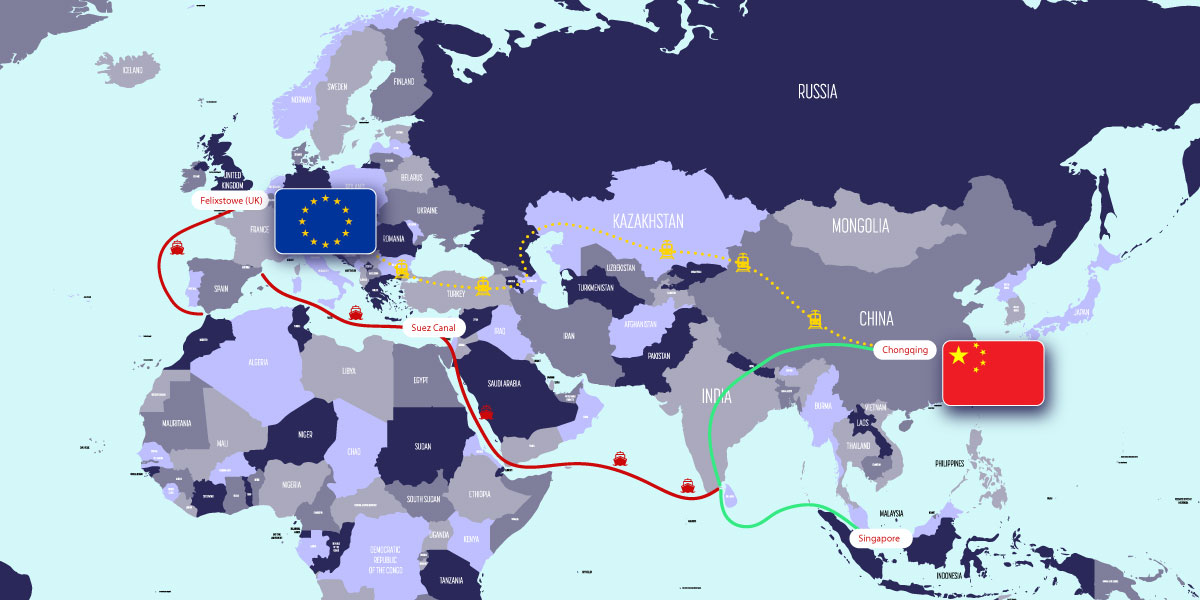
The platform connects the full network of global trade lanes and transport modes into a unified cost intelligence and commercial engine. When conditions shift — a port closure, a rate spike, a capacity withdrawal — the system immediately surfaces viable alternatives, fully costed and commercially evaluated, so teams can make decisions in minutes rather than days.
Forwarders gain the ability to proactively evaluate alternative tariffs across multiple hubs, model multimodal combinations when primary lanes are disrupted, assess transit time versus cost trade-offs with full margin visibility, and anticipate cost volatility across trade lanes before it affects commercial positions.
Critically, none of this intelligence sits in isolation. FreightGo is designed for full integration with the global TMS systems that forwarders already operate. Agreed tariffs can be published directly into autorating workflows, eliminating the manual transfer of rate decisions into operational systems. Live spot quotes for individual shipments can be pulled on demand, ensuring that every commercial interaction is backed by current market intelligence rather than static reference data.
The result is a fundamental shift in how forwarding organizations operate under pressure. Instead of managing disruption after it arrives, they move ahead of it — maintaining delivery commitments and protecting margins simultaneously.
Margin Discipline in an Unpredictable Market
Operational resilience without commercial discipline is not resilience — it is expensive improvisation.
What distinguishes FreightGo from conventional commercial tools is the depth of cost intelligence embedded in every decision. Forwarders do not simply see alternative tariffs. They see fully modeled cost structures, predicted surcharge movements, and margin outcomes across every viable option — before a commercial commitment is made.
This closes a gap that has long frustrated the industry: the disconnect between operational costing and commercial pricing. When those two functions operate from the same intelligence layer — and that layer is directly connected to the TMS systems where freight is actually executed — forwarders can adapt their networks dynamically while maintaining the margin discipline their businesses depend on.
Static tariffs and manual adjustments are no longer adequate instruments for a market that moves this fast.
The Forwarders Who Will Lead
The disruptions reshaping global trade — geopolitical realignments, infrastructure bottlenecks, energy volatility, shifting regulatory environments — are not temporary. They are structural features of the decade ahead.
Competitive advantage in this environment will not come from scale alone. It will come from superior intelligence: the ability to see the full landscape of options, model their commercial implications, and act faster than the market expects.
Sirma has spent over thirty years building technology for industries where complexity is not the exception but the condition. FreightGo brings that depth of engineering and domain understanding to one of the most operationally demanding sectors in the global economy.
The goal is not to help forwarders survive disruption. It is to give them the intelligence to turn disruption into a competitive advantage — while others are still figuring out their next move.
Ready to move beyond reactive logistics?